Why we built Chainworthy
Better maps never fixed navigation.Turn-by-turn direction did.
For decades, business intelligence was about maps: richer charts, more data, more dimensions. The maps got very good. The gap was never map quality. Someone still had to decide where to go next.
Chainworthy is built on a different premise: the goal is not better visibility. It is direction you can act on, tied to goals you care about, with outcomes you can measure.
Where Chainworthy fits.
The navigation analogy maps cleanly onto the three approaches most businesses use today.
Rand McNally
Traditional BI
The map
Shows where you are and where you have been. Accurate and detailed, but still requiring expertise to translate into direction. Tells you what happened. Does not close the loop.
→ Compare to BI toolsThe Sherpa
Management Consultants
The expert guide
Deep knowledge and outside perspective. High value, episodic, expensive, and gone when the engagement ends.
→ Compare to consultantsWaze
Chainworthy
Continuous direction
Always on. Surfaces the next best move when your data changes. Gets sharper as your goals, Context Library, and history accumulate. Priced for everyday use, not twice a year.
→ Compare to generic AIGPS did not replace maps. It answered a better question.
Think about what GPS actually changed.
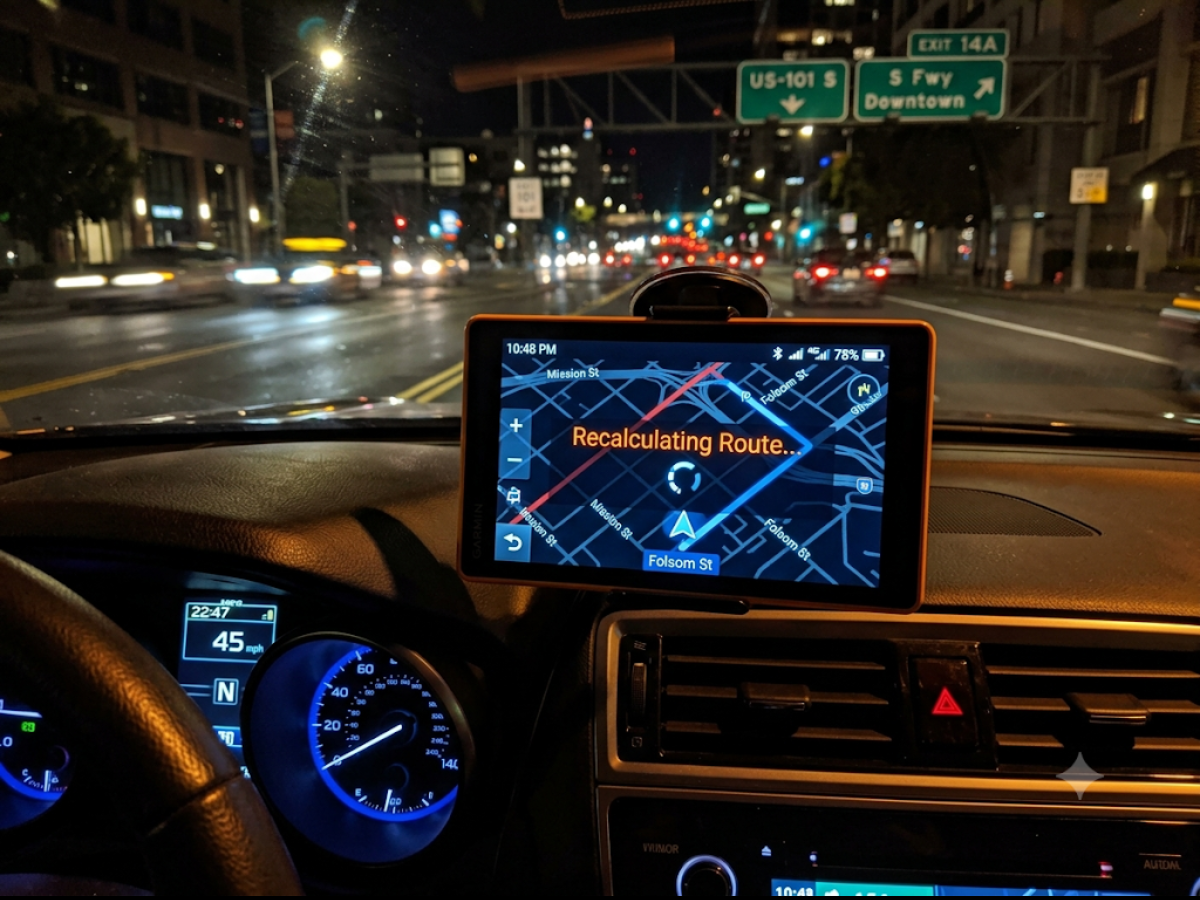
A perfect map still leaves you choosing the route, reading conditions, and updating when traffic shifts. GPS answers a different question: not "here is the terrain" but "here is your next turn." Not a static picture, but a system that recalculates when things change.
That is the shift Chainworthy makes for growth. Traditional BI is an excellent map. It shows your data clearly. It stops where interpretation begins, and interpretation is where the value lives.
Chainworthy is the turn-by-turn layer. It takes in your data, applies domain expertise and AI reasoning, and surfaces a specific answer to the question that matters:
Given everything we know about your business right now, what is your strongest next best move?
The best companies have always had this. Now everyone can.
Large enterprises use data science teams, analytics groups, and strategy consultants to turn data into direction. That rigor compounds: each insight informs the next, each decision gets measured.
Most mid-market growth teams do not have that infrastructure. They have a BI tool that shows charts, a consultant twice a year, and smart people making calls with incomplete information and limited time. Not because they are less capable, but because the tools were built for enterprise budgets and headcount.
Chainworthy closes that gap: consultant-quality recommendations, grounded in real data, with projected impact where supported, at software economics.
The best companies use data as a systematic advantage. Chainworthy is how growth-oriented teams do the same.
What "Chainworthy" actually means.
Not every signal deserves action. Most analytics produce noise: interesting patterns that do not move a goal, correlations without a clear next step. The challenge is knowing which insights earn attention.
Chainworthy is the bar. A recommendation is Chainworthy when it is grounded in your data, informed by proven domain expertise, financially projected with transparent assumptions, and specific enough to act on.
The name also reflects the chain: goal, KPI, finding, recommendation, action, tracked outcome, then re-measure. Links that stay connected. Progress you can prove. Activity logs what changed and when, so outcomes are auditable without relying on memory or spreadsheets.
On the roadmap, verifiable outcome records will build on granted patent protection in blockchain architecture. That capability is not live today. The chain is already real in the product: closed-loop goals, auditable Activity, and recommendations your team can defend.
Not every insight deserves action. Chainworthy finds the ones that do.
The north star.
Chainworthy is not another BI tool or a generic AI assistant. We are building an AI growth strategist that monitors your goals, applies decades of encoded expertise, and helps your team decide the next best move with evidence.
Consultant-grade direction for growth-oriented teams that are done navigating by map alone.
Domain-trained recommendations. Secure data. Always on.